
Subscribe to download data and additional chart formats.
Republish this chart? Charts must be used as is — no customisation, editing or cropping. The Outlier logo must remain on the chart unchanged.
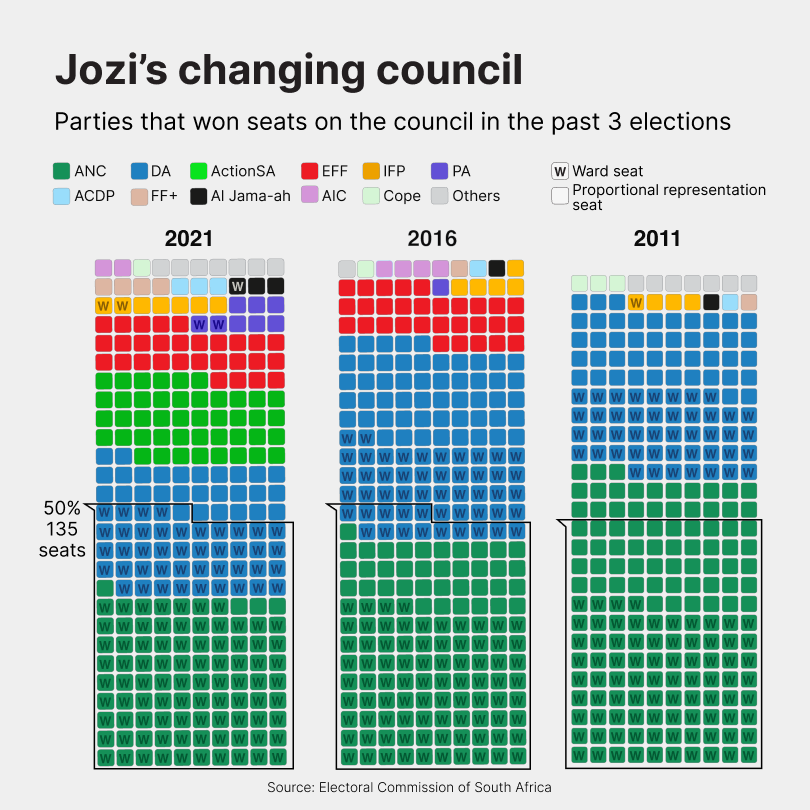
There was a time when the ANC had the majority of seats on Johannesburg’s council, the body that makes the important decisions about the city’s budget, by-laws, services and development. But that was 15 years ago, after the 2011 local government elections, when it won 153 of the 260 seats. It lost that majority in 2016, shedding 32 seats. With 121 seats, it was just 17 seats ahead of the DA. The Economic Freedom Fighters, formed in 2013, and joining the council for the first time, were in a powerful position with their 30 seats.
In the 2021 election the ANC lost another 30 seats. But the DA lost 33 and ActionSA entered the fray scooping up 44 seats, the EFF held on to 29. The Patriotic Alliance won eight seats, up from just one in 2016, and the IFP did better than it had in years. Fragile coalitions became the order of the day.
What will happen in the 2026 elections? If no party wins an outright majority of seats then the coalitions will continue, but this time it’s critical the parties play nice and learn to work together for the benefit of the city.
In collaboration with Our City News