
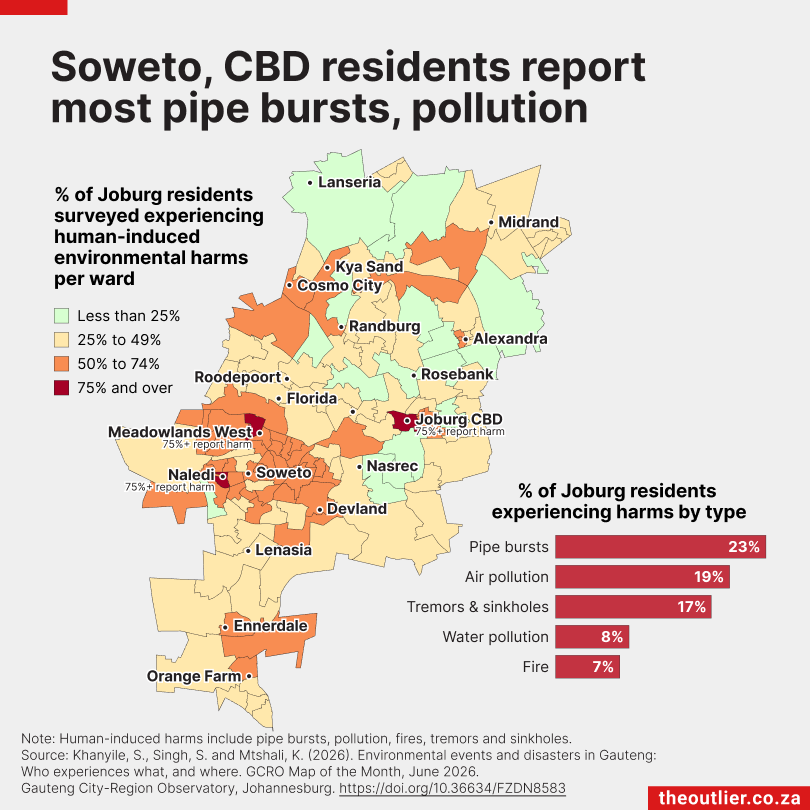
Almost one in four people surveyed in Johannesburg experienced water and sewage pipe bursts, according to data from the Gauteng City-Region Observatory (GCRO). The next most common human-induced harm was air pollution, affecting 19% of respondents, followed by tremors and sinkholes (17%), a legacy of Johannesburg's dolomitic ground and mining history, along with smaller shares from water pollution (8%) and fire (7%).
The GCRO attributes human-induced disasters to ageing, poorly maintained infrastructure, industrial activity near residential areas, and limited capacity to prevent or recover from failures.
Taken together, these five harms, pipe bursts, air and water pollution, tremors and sinkholes, and fire, show a starkly uneven geography across the city. Reported damage is concentrated in Soweto and the Johannesburg CBD, both near industrial activity, where at least 75% of residents surveyed reported experiencing some form of human induced-harm.
Even when households face the same disaster, the GCRO notes, the impact is different based on the quality of the house, the family’s financial resources, and their capacity to recover.
Produced in partnership with Our City News.