
A war that began on 28 February, more than 5,000km away, is now felt at every African pump. Iran's closure of the Strait of Hormuz choked off a fifth of the world's oil shipments, and the cost has worked its way down to drivers across the continent.
In Kenya, it turned deadly. Four people were killed and more than 30 injured this week in protests against fuel prices. A nationwide transport strike also brought the country to a standstill. Note: Kenya is not in the chart below because despite hefty increases it still is not among the countries with the largest increases over the period, even though the price of petrol and diesel in Kenya is above the continental average.
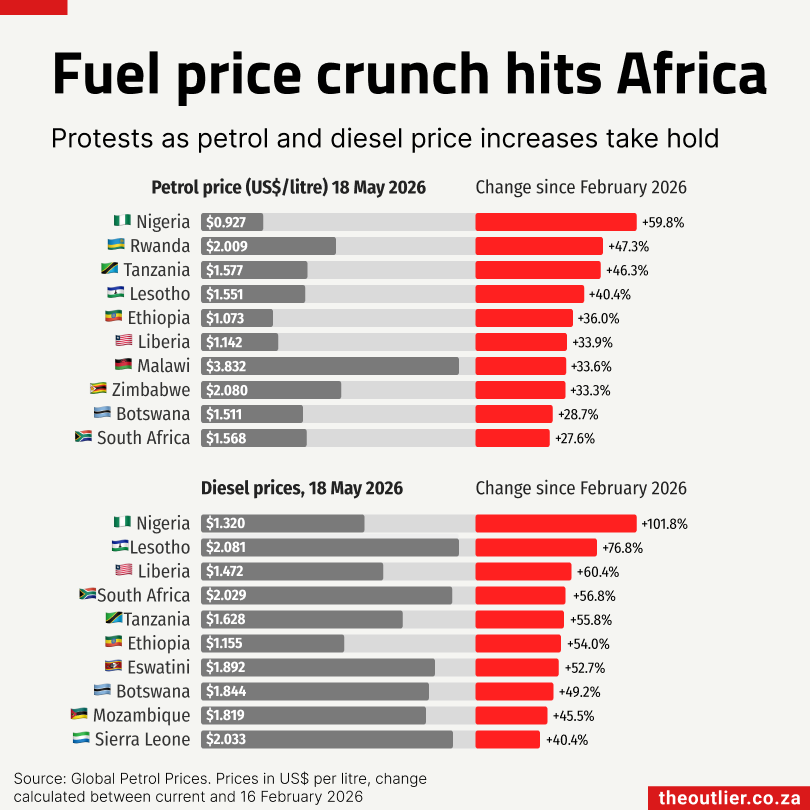
The chart also shows two things at once: what fuel costs now, and how much the price has jumped since February. They don't always move together.
Take Nigeria. It has the cheapest petrol at $0.93 a litre, yet the price rose the most: nearly 60%. Its diesel did the same, more than doubling. That looks like a contradiction. It isn't. Nigeria refines its own fuel at the giant Dangote plant near Lagos, so it starts from a very low base. But it still buys crude at the global price. When crude jumps, even a home refiner passes some cost on. A big rise on a small starting price makes a huge percentage. The fuel is still cheap.
For South Africans, the pain is sharper. Petrol sits at $1.57 a litre and diesel at $2.03. Diesel breached R32 a litre for the first time in May. Treasury cut the fuel levy to soften the blow, which is why our petrol rise of 28% looks mild next to Nigeria's. The result still showed up fast: inflation hit 4% in April, a 20-month high, driven by fuel.
Petrol hits drivers in the pocket but it is diesel that is really worth watching as it moves the economy, and a change there has noticeable impacts across the country.
 Access Premium Data