
Subscribe to download data and additional chart formats.
Republish this chart? Charts must be used as is — no customisation, editing or cropping. The Outlier logo must remain on the chart unchanged.
Transnet is reporting a turnaround. Volumes are up. But the Draft National Rail Master Plan sets a 2030 target of 250-million tonnes. Transnet is currently moving 168-million tonnes a year. That leaves roughly 80-million tonnes that still travels by truck instead of train — and truck freight in South Africa is expensive and steadily destroying the roads it runs on.
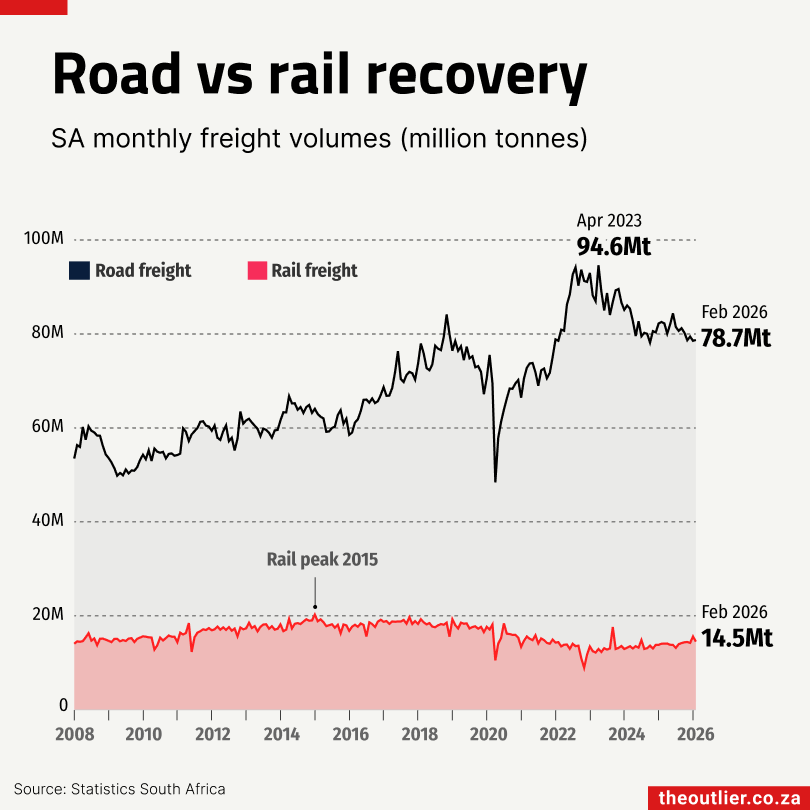
Rail freight peaked at 226.6-million tonnes in the 2015 financial year, according to Transnet's annual reports. Then came a six-year slide, the result of deferred maintenance, equipment failure, vandalism and reduced infrastructure investment. By 2023, Transnet was carrying 149.5-million tonnes, a level not seen since the early 2010s. Recovery has begun since that low, but on a chart it reads as a small upward tick at the bottom of a cliff.
As rail fell, road didn't just take up the slack, it ballooned. Statistics South Africa's freight transport survey shows monthly rail volumes peaked at around 19-million tonnes in 2015 and have since declined to 13- to 15-million tonnes. Road freight moved in the opposite direction: from roughly 53-million tonnes a month in 2008 to more than 80-million tonnes today. Rail dropped by a third while road freight climbed past 218-million tonnes annually. The more expensive, more damaging mode became dominant precisely as the cheaper, more efficient one failed.
For more read: https://theoutlier.co.za/features/road-vs-rail